Our weekend of activities and talks is supplemented by an ongoing exhibition with the Bath School of Art and Design, and the Charity WildScreen.
Jo Atherton
In addition to leading a special flotsam-weaving workshop we will be displaying some of Jo's most recent pieces as part of our ongoing exhibition with the Aquarium
Anthropocene (2016) is a print created by inking plastic objects gathered on the UK coast.
The circular composition of my prints mimic the microscopic marine world seen by those researching the effects of microplastics in our fragile oceans, bringing into focus human impacts at both a minuscule and planetary level. Central to my work is an exploration of how the ubiquity of plastic characterises the geological age of human influence – the Anthropocene. Millions of years ago, fuelled by sunlight, marine plankton flourished and then settled on the ocean floor, slowly transforming into oil. This same oil is used to quickly produce the endless plastic objects that dominate the everyday. When inked and printed, plastic flotsam fragments bear a stark resemblance to the rich diversity of microscopic marine life – a worrying and ironic connection to a beautiful natural process.
High Water Mark (2016) is one of four pieces created during a residency at Cape Cornwall in 2016.
These ink and print compositions were inspired by the deep time permanence of the craggy Cornish coastline and wistful, temporary arrangement of plastic flotsam along the shore. Deep and transitory timelines converge in a circular composition, echoing the plankton of a microscopic world, single use plastic and its enduring legacy. Many of the colours mimic the ores, minerals and waters of the coast, contrasted with the regularity of the 2016 tide time tables for the region, reminding us of the relentless natural forces at work, like a coastal metronome.
Cyanotype prints (2018)
This primitive photography technique relies on the sun to expose shadows of objects placed on UV sensitive paper. Working with solar energy to create these compositions was a technique I wanted to employ to highlight our reliance on the sun's energy, not just as humans, but all creatures. Indeed, the microscopic plankton which settled on the ocean floor to form crude oil are used today in creating the seemingly endless stream of single use plastic objects which abound in our lives. Reliant on the sun's rays to live, these tiny, ancient creatures formed a substance which we are so reliant on today, as both oil and its many derivatives.
For more follow @FltosamWeaving or check out https://joatherton.com/
In addition to leading a special flotsam-weaving workshop we will be displaying some of Jo's most recent pieces as part of our ongoing exhibition with the Aquarium
Anthropocene (2016) is a print created by inking plastic objects gathered on the UK coast.
The circular composition of my prints mimic the microscopic marine world seen by those researching the effects of microplastics in our fragile oceans, bringing into focus human impacts at both a minuscule and planetary level. Central to my work is an exploration of how the ubiquity of plastic characterises the geological age of human influence – the Anthropocene. Millions of years ago, fuelled by sunlight, marine plankton flourished and then settled on the ocean floor, slowly transforming into oil. This same oil is used to quickly produce the endless plastic objects that dominate the everyday. When inked and printed, plastic flotsam fragments bear a stark resemblance to the rich diversity of microscopic marine life – a worrying and ironic connection to a beautiful natural process.
High Water Mark (2016) is one of four pieces created during a residency at Cape Cornwall in 2016.
These ink and print compositions were inspired by the deep time permanence of the craggy Cornish coastline and wistful, temporary arrangement of plastic flotsam along the shore. Deep and transitory timelines converge in a circular composition, echoing the plankton of a microscopic world, single use plastic and its enduring legacy. Many of the colours mimic the ores, minerals and waters of the coast, contrasted with the regularity of the 2016 tide time tables for the region, reminding us of the relentless natural forces at work, like a coastal metronome.
Cyanotype prints (2018)
This primitive photography technique relies on the sun to expose shadows of objects placed on UV sensitive paper. Working with solar energy to create these compositions was a technique I wanted to employ to highlight our reliance on the sun's energy, not just as humans, but all creatures. Indeed, the microscopic plankton which settled on the ocean floor to form crude oil are used today in creating the seemingly endless stream of single use plastic objects which abound in our lives. Reliant on the sun's rays to live, these tiny, ancient creatures formed a substance which we are so reliant on today, as both oil and its many derivatives.
For more follow @FltosamWeaving or check out https://joatherton.com/
Kerry Curtis is Assistant Dean at Bath School of Art and Design, Bath Spa University. Her creative practice explores preparing for an uncertain future as climate change impacts the natural world and humanities role within it. The overarching research project is titled ‘Imagining Neutopia’, comprising of sub projects and collaborative activities asking design-led questions, presenting fictional narratives and curating responses. The research aims to influence positive behavioural change in individuals, in thinking about and preparing for, our future environment.
The #oceanmatterstoartanddesign exhibition is conceived as a survey approach in understanding how the Bath School of Art and Design students and staff are engaging with the issue of ocean plastic. The intentionally short open call for submission was designed to involve a light-touch commitment from applicants, so that a snapshot of current work in progress could be quickly captured. Submissions were requested through instagram giving immediacy to the project, encouraging the sharing of environmental creative practice, and offering a platform for dialogue and communities of engagement to develop. See below for some of our student entries.
Alison Jane Hoare is a postgraduate student at Bath School of Art and Design, studying MA Curatorial Practice. As a curator she sees her role as a mediator between artistic expression and public perception. The artists showing in #OCEANMATTERS are reflecting on the political, social and visual conditions of our oceans through their individual practices, yet, crucial to the cause, the curatorial processes for the exhibition have produced a vast amount of plastic waste. Through this transparency we are encouraging people to think about their own plastic footprints, our oceans and the environment.
The #oceanmatterstoartanddesign exhibition is conceived as a survey approach in understanding how the Bath School of Art and Design students and staff are engaging with the issue of ocean plastic. The intentionally short open call for submission was designed to involve a light-touch commitment from applicants, so that a snapshot of current work in progress could be quickly captured. Submissions were requested through instagram giving immediacy to the project, encouraging the sharing of environmental creative practice, and offering a platform for dialogue and communities of engagement to develop. See below for some of our student entries.
Alison Jane Hoare is a postgraduate student at Bath School of Art and Design, studying MA Curatorial Practice. As a curator she sees her role as a mediator between artistic expression and public perception. The artists showing in #OCEANMATTERS are reflecting on the political, social and visual conditions of our oceans through their individual practices, yet, crucial to the cause, the curatorial processes for the exhibition have produced a vast amount of plastic waste. Through this transparency we are encouraging people to think about their own plastic footprints, our oceans and the environment.
Sea Creatures Have Feelings Too
Rachel Falber
This image is from a series Rachel created called ‘Sea creatures have feelings too’ it’s a slightly tongue in cheek name but the reasons behind the name are rather more sombre. The oceans are getting choked in plastic and the often very clever and sentient sea life who live there are getting irreversibly affected because of it. Plastic particles are being found in all sorts of sea creatures and populations of some animals are dwindling. These designs are Rachel's attempt at bringing awareness to these issues through a series of drawings depicting heartfelt themes and feelings that we can relate to as humans. Rachel's intention is to carry on and grow this collection of work, in the near future she wants to team up with a sea creature charity in some way to help the cause. Rachel's ethos as a human and business owner is one of responsibility and awareness, she keeps her carbon footprint as low as she can and only uses recycled and renewable materials and packaging at home and at work.
For more see @hareraisingdesigns or visit www.hareraisingdesigns.com
Rachel Falber
This image is from a series Rachel created called ‘Sea creatures have feelings too’ it’s a slightly tongue in cheek name but the reasons behind the name are rather more sombre. The oceans are getting choked in plastic and the often very clever and sentient sea life who live there are getting irreversibly affected because of it. Plastic particles are being found in all sorts of sea creatures and populations of some animals are dwindling. These designs are Rachel's attempt at bringing awareness to these issues through a series of drawings depicting heartfelt themes and feelings that we can relate to as humans. Rachel's intention is to carry on and grow this collection of work, in the near future she wants to team up with a sea creature charity in some way to help the cause. Rachel's ethos as a human and business owner is one of responsibility and awareness, she keeps her carbon footprint as low as she can and only uses recycled and renewable materials and packaging at home and at work.
For more see @hareraisingdesigns or visit www.hareraisingdesigns.com
It Is Not Enough
Sandra Chin
In her works Sandra questions our place in this world and how our actions, and indeed inactions, impact the environment. This exhibition is a welcome opportunity to raise awareness about the fact that once plastic has been
produced and used, it needs to be disposed of. Recycling is good but reducing plastic is better. Up to 12.7 million tonnes of plastic enter the oceans yearly and the number is on the rise (Greenpeace, 2018).
Recycled materials were used to create the artwork and instead of glue the fragments are stitched together. Piercing the surface of the paper left permanent and lasting marks that can never be reversed. The disposing of plastic in an irresponsible manner has devastating consequences to marine life and ecosystems. The combination of strong sewn connections on rather delicate paper, highlight the ephemeral qualities of the natural world. The lines represent global links. Environmental issues need to be seen across borders. It might seem like a drop in the ocean but the voice of the individual counts and we need to take action to stop the rapidly rising sea of plastic.
For more follow @san.chin or check out www.sandrachin.co.uk
Sandra Chin
In her works Sandra questions our place in this world and how our actions, and indeed inactions, impact the environment. This exhibition is a welcome opportunity to raise awareness about the fact that once plastic has been
produced and used, it needs to be disposed of. Recycling is good but reducing plastic is better. Up to 12.7 million tonnes of plastic enter the oceans yearly and the number is on the rise (Greenpeace, 2018).
Recycled materials were used to create the artwork and instead of glue the fragments are stitched together. Piercing the surface of the paper left permanent and lasting marks that can never be reversed. The disposing of plastic in an irresponsible manner has devastating consequences to marine life and ecosystems. The combination of strong sewn connections on rather delicate paper, highlight the ephemeral qualities of the natural world. The lines represent global links. Environmental issues need to be seen across borders. It might seem like a drop in the ocean but the voice of the individual counts and we need to take action to stop the rapidly rising sea of plastic.
For more follow @san.chin or check out www.sandrachin.co.uk
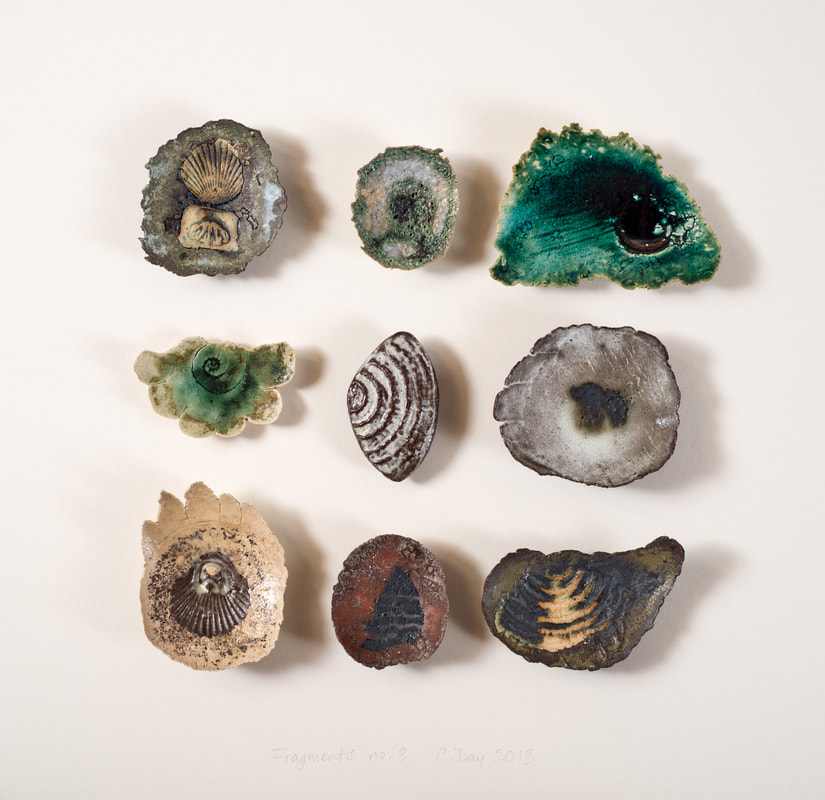
Fragments No. 3
Clare Day
Clare Day is an artist who works in clay and makes prints, as well as working to support creativity in others. There are many layers to her work, it is about surfaces, texture, and imprint (both imprint in a physical sense and imprint in a wider context). The ceramic pieces are hand built, sometimes using press moulds, and imprinted using found objects and clay stamps that she has made. Layers are built up of glazes, oxides and even small fragments of found glass. The work is on a mainly human scale; something you can hold in your hand. Found objects from the shoreline are often a feature of her work, and increasingly the fragments that are found and pressed into the clay are sadly fragments of plastic.
For more follow @claredayceramic or visit www.claredayceramics.com
Clare Day
Clare Day is an artist who works in clay and makes prints, as well as working to support creativity in others. There are many layers to her work, it is about surfaces, texture, and imprint (both imprint in a physical sense and imprint in a wider context). The ceramic pieces are hand built, sometimes using press moulds, and imprinted using found objects and clay stamps that she has made. Layers are built up of glazes, oxides and even small fragments of found glass. The work is on a mainly human scale; something you can hold in your hand. Found objects from the shoreline are often a feature of her work, and increasingly the fragments that are found and pressed into the clay are sadly fragments of plastic.
For more follow @claredayceramic or visit www.claredayceramics.com
|
|
Do you need a bag?
Kathryn Symonds
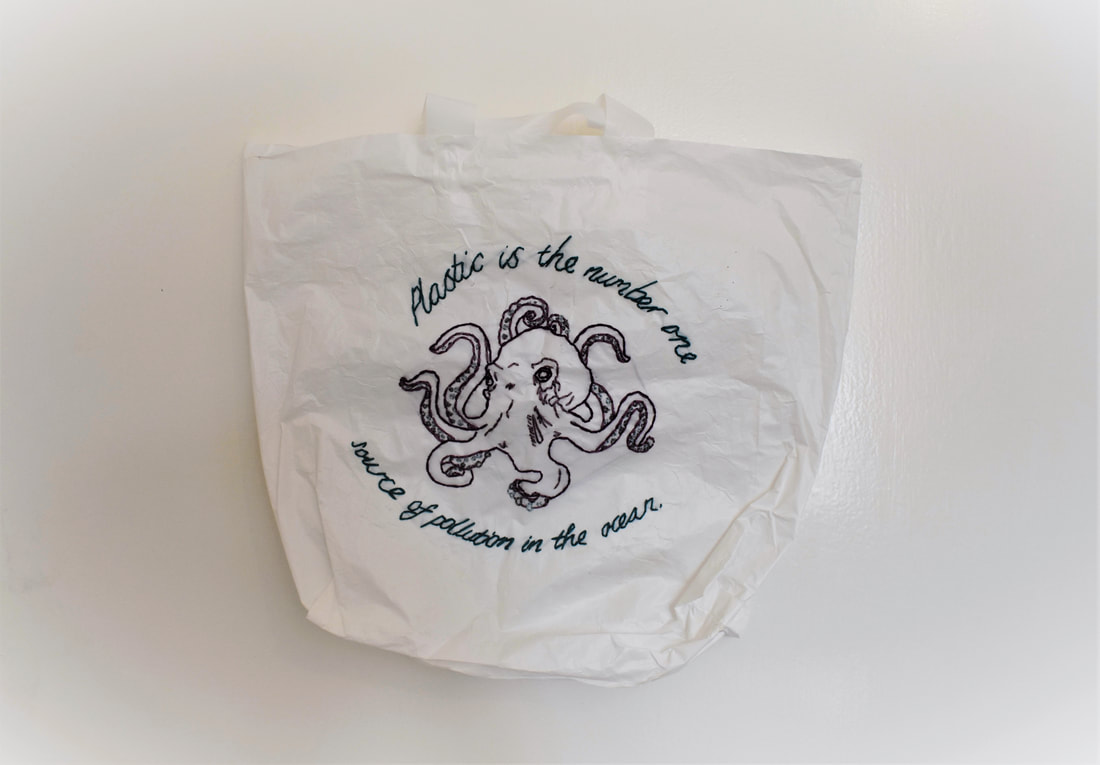
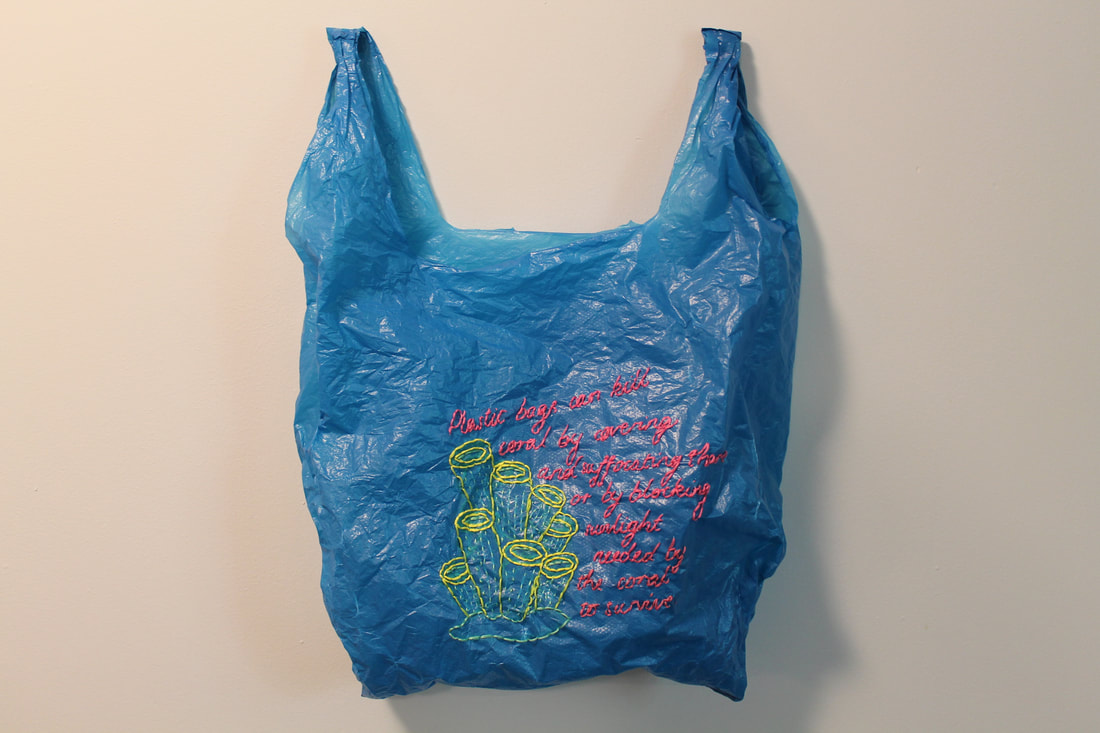
"Do you need a bag?” is a phrase we often hear day to day - a simple question with an often devastating answer that most people put no thought into. The affects of plastic pollution on marine life is becoming increasingly more serious, and so raising awareness on this issue is central to Kathryn’s work. In her current series she has created a range of hand-embroidered plastic bags, displaying facts on the detrimental affects of plastic. With the plastic bags coming from Kathryn’s own usage, and collecting them from friends and family this helps the material to be recycled and repurposed to create this piece of artwork - hopefully making people aware of their plastic usage, and encouraging others to recycle and think twice before saying yes to a 5p bag.
For more follow @kathrynmaysymonds or see kathrynmaysymonds.wordpress.com
Kathryn Symonds
"Do you need a bag?” is a phrase we often hear day to day - a simple question with an often devastating answer that most people put no thought into. The affects of plastic pollution on marine life is becoming increasingly more serious, and so raising awareness on this issue is central to Kathryn’s work. In her current series she has created a range of hand-embroidered plastic bags, displaying facts on the detrimental affects of plastic. With the plastic bags coming from Kathryn’s own usage, and collecting them from friends and family this helps the material to be recycled and repurposed to create this piece of artwork - hopefully making people aware of their plastic usage, and encouraging others to recycle and think twice before saying yes to a 5p bag.
For more follow @kathrynmaysymonds or see kathrynmaysymonds.wordpress.com
|
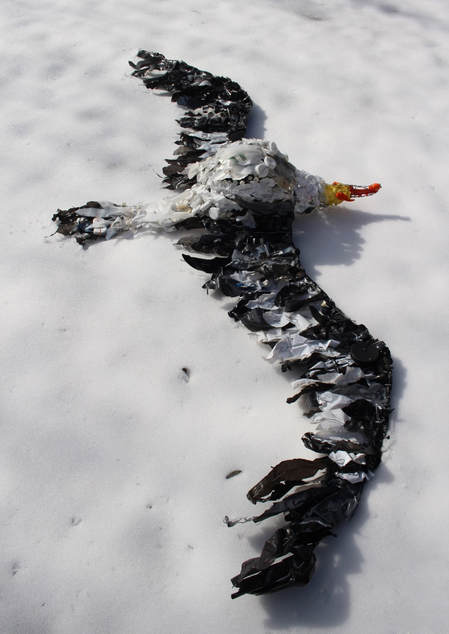
Albatross
Fiona Campbell Environmental concerns are important to Fiona. In addition to her own practice, involving labour-intensive handmade processes, she works within the community on collaborative art projects, using found, reclaimed and discarded materials, giving them a new life. This relates to the issue of waste, our relationship with matter, nature and ourselves. Fiona created the Albatross sculpture with schoolchildren Years 4-8 at Hazlegrove Prep School, Somerset - now sited permanently in their school atrium. Made from recycled plastic and wire, it was inspired by the plight of thousands of albatross chicks dying from bloated stomachs filled with plastic. Their parents mistake floating objects like lighters and bottle tops for morsels of fish. Disturbed by these realities, Fiona also created a site-specific response ‘Instead of a Cross, an Albatross’ in a residency at Walcot Chapel, Bath, linked to Coleridge’s Rime of the Ancient Mariner, as a kind of altarpiece. She has been inspired by the film ‘A Plastic Ocean’, which reveals hard-hitting facts: micro plastic is in every single organism in our seas and 80% of plastic from landfills leaks into the ocean. For further information about follow @FionaSculpture (twitter) @FionaCampbellArtist (insta) or visit www.fionacampbellart.co.uk |
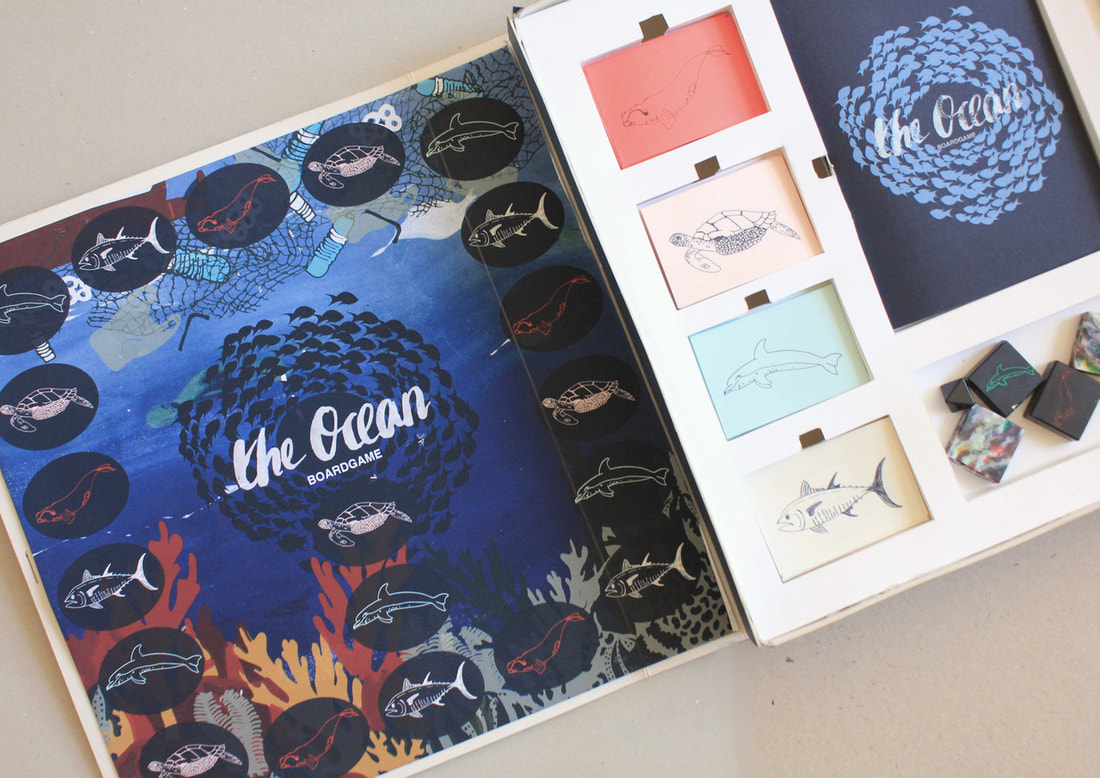
The Ocean Board-game
Madeleine Pilkington
The Ocean is an eco-friendly game designed to encourage children to learn and care about the environment. The board and box are made from G.F. Smith Extract Paper which uses recycled coffee cups that aren’t usually recycled due to the plastic coating. The board pieces used to move around the board are also made from recycled plastic. Plastic is the biggest contributor to pollution in our oceans and by playing The Ocean Board-game you are educating yourself on the ocean but are also reusing plastic that would otherwise end up degrading in our oceans harming our wildlife. Each section of the board shows a different threat to the ocean, the top right and left corners represent shipping and pollution with the bottom right hand corner coral bleaching. You have to navigate your way around the board answering questions correctly on the wildlife and their threats in order to make it back to the middle to win.
For more see @mpilkingtongraphics or madeleine.pilkington.myportfolio.com
Madeleine Pilkington
The Ocean is an eco-friendly game designed to encourage children to learn and care about the environment. The board and box are made from G.F. Smith Extract Paper which uses recycled coffee cups that aren’t usually recycled due to the plastic coating. The board pieces used to move around the board are also made from recycled plastic. Plastic is the biggest contributor to pollution in our oceans and by playing The Ocean Board-game you are educating yourself on the ocean but are also reusing plastic that would otherwise end up degrading in our oceans harming our wildlife. Each section of the board shows a different threat to the ocean, the top right and left corners represent shipping and pollution with the bottom right hand corner coral bleaching. You have to navigate your way around the board answering questions correctly on the wildlife and their threats in order to make it back to the middle to win.
For more see @mpilkingtongraphics or madeleine.pilkington.myportfolio.com
|
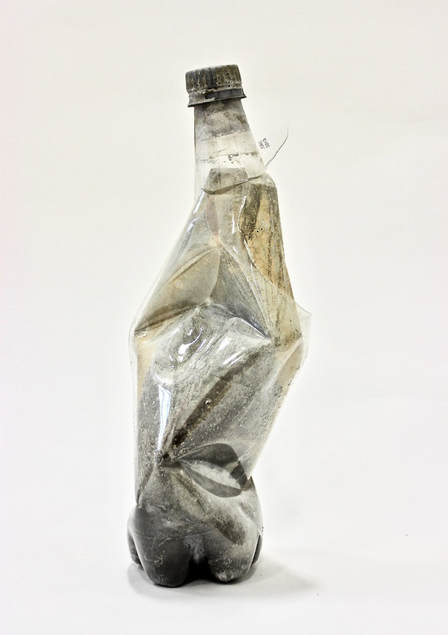
Solid Plastic
Jasmin Heard Jasmin is currently a Fine Art student at Bath Spa University, and the main focus of her work is looking at human impact upon the natural environment. From a very young age, she has been hyper-aware of the negative changes being made to our environment and what little has been done to reverse the effects. Topics such as Deforestation and Plastic Pollution have both been dominant throughout her previous and current work. Jasmin tries to raise awareness of these issues through my artwork, and has even written a book on plastics effect on the ocean for her Foundation Art Degree. With her current work, she has been combining Photography and Sculpture to show plastic as a heavier, more permanent and less disposable material. With 8 million metric tonnes of plastic ending up in the oceans every year, a staggering amount being plastic bottles alone, she poses these questions: If plastic bottles were looked at as a solid, indestructible material, would we change the way we look at them? Would we be so willing to throw them away? For more follow @jasminrheard or check out jazheard13.wixsite.com/fineart |
|
Ocean Oils
Freya Hill
The ocean has always been a constant inspiration for Freya's art. Her practice is about exploring the surface of the ocean and the different ways we can look at it. How the sea constantly changes and that every time we look at it, we see a unique snapshot that will never be repeated. This is why her compositions are squares: like a polaroid or a viewfinder of that particular moment. The sea covers the entire surface of the paintings with the same amount of detail spread across it to suggest that I’ve captured a small section of the vast, never-ending ocean. She paints the ocean as she sees it by showing its true colours and shapes and how the light reflects off from the surface of it. Working from photographs and screen-shots from documentaries about the ocean is important in her working process as they give her references and compositions for her paintings. She uses oil paints as they produce a rich, vibrant colour when applied and it also have structure to it that forms the waves in my sea paintings.
As an artist, Freya wants her paintings to show the beauty of the ocean but also how it can be terrifying to people. The sea is something that brings her happiness and a feeling of familiarity and comfort which is why she enjoys translating it into art.
For more follow @freyahill art or check out www.freyahill.co.uk
Freya Hill
The ocean has always been a constant inspiration for Freya's art. Her practice is about exploring the surface of the ocean and the different ways we can look at it. How the sea constantly changes and that every time we look at it, we see a unique snapshot that will never be repeated. This is why her compositions are squares: like a polaroid or a viewfinder of that particular moment. The sea covers the entire surface of the paintings with the same amount of detail spread across it to suggest that I’ve captured a small section of the vast, never-ending ocean. She paints the ocean as she sees it by showing its true colours and shapes and how the light reflects off from the surface of it. Working from photographs and screen-shots from documentaries about the ocean is important in her working process as they give her references and compositions for her paintings. She uses oil paints as they produce a rich, vibrant colour when applied and it also have structure to it that forms the waves in my sea paintings.
As an artist, Freya wants her paintings to show the beauty of the ocean but also how it can be terrifying to people. The sea is something that brings her happiness and a feeling of familiarity and comfort which is why she enjoys translating it into art.
For more follow @freyahill art or check out www.freyahill.co.uk
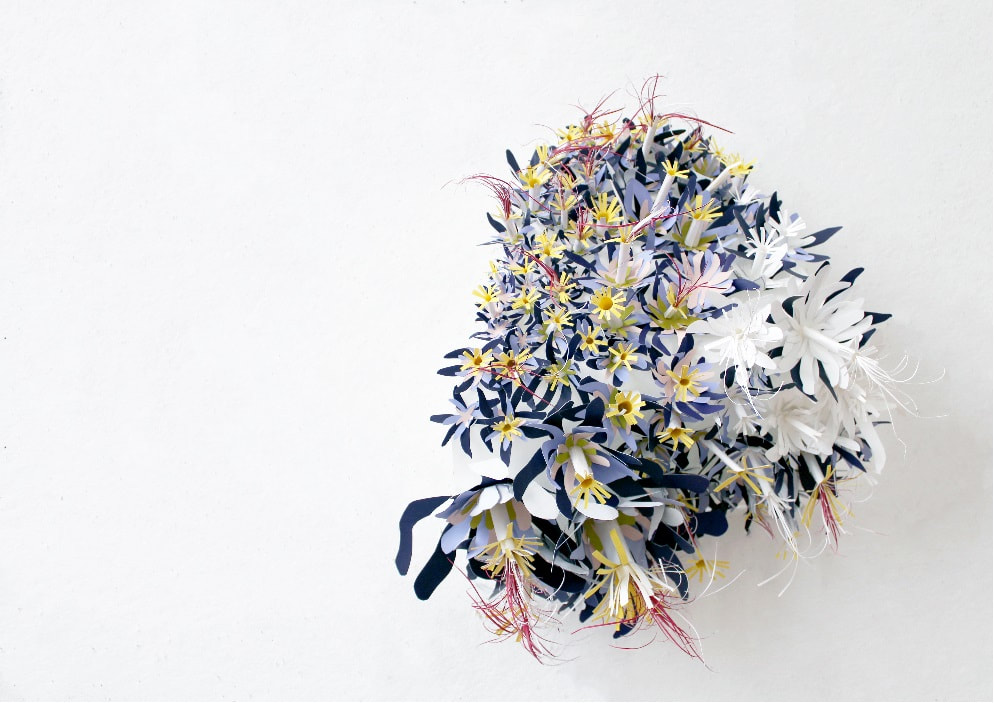
Coral Bleaching
Imogen Rhodes-Davies
Imogen Rhodes-Davies is an embroidery and embellishment designer for fashion. She will be graduating from Bath School of Art and Design in June 2018. Imogen has a passion for building texture into her work, mixing traditional embroidery techniques and unconventional materials to construct contemporary 3D pieces. She uses materials not always associated with embroidery, for example manipulating plastic to create a 3D image and juxtaposes this with delicate embroidery and beadwork. Using different materials creates layers within the work, making the viewer look deep into the body of the embellishment.
This piece was inspired by coral bleaching and was created for Imogen’s degree collection. Environmental issues are a great source of inspiration and give her work a meaning. The texture of the coral was something she could translate into an embroidery piece. There are a huge variety of shapes and forms of coral, perfect for reinterpreting as embellishment designs, while the colours of coral are spectacular, ranging from vivid purple and lime greens to pastel lilac and peach; making the bleaching of the coral all the more heart-breaking.
This piece was created in the early stages of the project, investigating how to turn the coral elements into couture pieces for fashion. It is made entirely of paper, some of the paper is left white to represent the bleaching, while the use of paper represents the fragility of coral today.
For more follow @imogenmelissa_embroidery or email [email protected]
Imogen Rhodes-Davies
Imogen Rhodes-Davies is an embroidery and embellishment designer for fashion. She will be graduating from Bath School of Art and Design in June 2018. Imogen has a passion for building texture into her work, mixing traditional embroidery techniques and unconventional materials to construct contemporary 3D pieces. She uses materials not always associated with embroidery, for example manipulating plastic to create a 3D image and juxtaposes this with delicate embroidery and beadwork. Using different materials creates layers within the work, making the viewer look deep into the body of the embellishment.
This piece was inspired by coral bleaching and was created for Imogen’s degree collection. Environmental issues are a great source of inspiration and give her work a meaning. The texture of the coral was something she could translate into an embroidery piece. There are a huge variety of shapes and forms of coral, perfect for reinterpreting as embellishment designs, while the colours of coral are spectacular, ranging from vivid purple and lime greens to pastel lilac and peach; making the bleaching of the coral all the more heart-breaking.
This piece was created in the early stages of the project, investigating how to turn the coral elements into couture pieces for fashion. It is made entirely of paper, some of the paper is left white to represent the bleaching, while the use of paper represents the fragility of coral today.
For more follow @imogenmelissa_embroidery or email [email protected]
Seascapes
Kathyrn Champion
Kate is a Fine Art student at Bath Spa University. Her current practice is driven by an exploration of the application of paint within Seascapes. Having grown up living by the Welsh Coast, it has become a place of great importance to her. Her work aims to demonstrate the invisibility of the global plastic ocean crisis and emphasise how we take the oceans for granted as a thing of beauty and don’t realise how much we are harming them.
She is particularly drawn to the tension between land, sea and sky and the strong sense of the horizontal. As a result, her paintings are habitually split into these three elements and contain a strong horizon line, giving a solid depth of field. Kate also creates tension within her paintings by exploring the boundary between abstract and representational, through the application of paint. The experimentation of texture and materials holds an integral place within her work. She has been looking at how less conventional materials, including materials taken from the beach, can be used within painting, to create a more diverse range of texture and give a stronger sense of place to the paintings. Kate plans to incorporate plastic found along the shoreline of local beaches into future paintings to further highlight the issues of the vast amount of plastic debris hidden within our oceans.
Kate feels that exploring new techniques and combinations of mediums brings dynamicity and life to her paintings. The exploration of paint and materials within Seascapes is vital to her practice, enabling her to portray her passion for the ocean and its ever-changing surroundings.
For more follow @KateChampion_Art
Kathyrn Champion
Kate is a Fine Art student at Bath Spa University. Her current practice is driven by an exploration of the application of paint within Seascapes. Having grown up living by the Welsh Coast, it has become a place of great importance to her. Her work aims to demonstrate the invisibility of the global plastic ocean crisis and emphasise how we take the oceans for granted as a thing of beauty and don’t realise how much we are harming them.
She is particularly drawn to the tension between land, sea and sky and the strong sense of the horizontal. As a result, her paintings are habitually split into these three elements and contain a strong horizon line, giving a solid depth of field. Kate also creates tension within her paintings by exploring the boundary between abstract and representational, through the application of paint. The experimentation of texture and materials holds an integral place within her work. She has been looking at how less conventional materials, including materials taken from the beach, can be used within painting, to create a more diverse range of texture and give a stronger sense of place to the paintings. Kate plans to incorporate plastic found along the shoreline of local beaches into future paintings to further highlight the issues of the vast amount of plastic debris hidden within our oceans.
Kate feels that exploring new techniques and combinations of mediums brings dynamicity and life to her paintings. The exploration of paint and materials within Seascapes is vital to her practice, enabling her to portray her passion for the ocean and its ever-changing surroundings.
For more follow @KateChampion_Art
GYRE
Dave Bone
An estimated twelve million tonnes of waste plastic ends up in the world’s oceans each year, a permanent reminder of the geological footprint we are to leave behind. A global threat on a monumental scale that will forever change the ecosystems of our natural world, with estimates there will be more plastic floating in our seas than fish by 2050. 'Gyre' is a visual representation of the issues surrounding our own consumer culture, as well as plastic's relationship with the environment. The abstract compositions are suggestive of the convergence of manufactured and organic material. Whilst the distortion of its structure intends to disorientate yet create resonance and familiarity through its everyday use as a consumable. 'Gyre' presents a visual enquiry into self-reflection through an archival examination of household commodities, through natural landscapes and to the unseen and optimistic resilience of human intervention.
For more see @Davebonephotography
Dave Bone
An estimated twelve million tonnes of waste plastic ends up in the world’s oceans each year, a permanent reminder of the geological footprint we are to leave behind. A global threat on a monumental scale that will forever change the ecosystems of our natural world, with estimates there will be more plastic floating in our seas than fish by 2050. 'Gyre' is a visual representation of the issues surrounding our own consumer culture, as well as plastic's relationship with the environment. The abstract compositions are suggestive of the convergence of manufactured and organic material. Whilst the distortion of its structure intends to disorientate yet create resonance and familiarity through its everyday use as a consumable. 'Gyre' presents a visual enquiry into self-reflection through an archival examination of household commodities, through natural landscapes and to the unseen and optimistic resilience of human intervention.
For more see @Davebonephotography
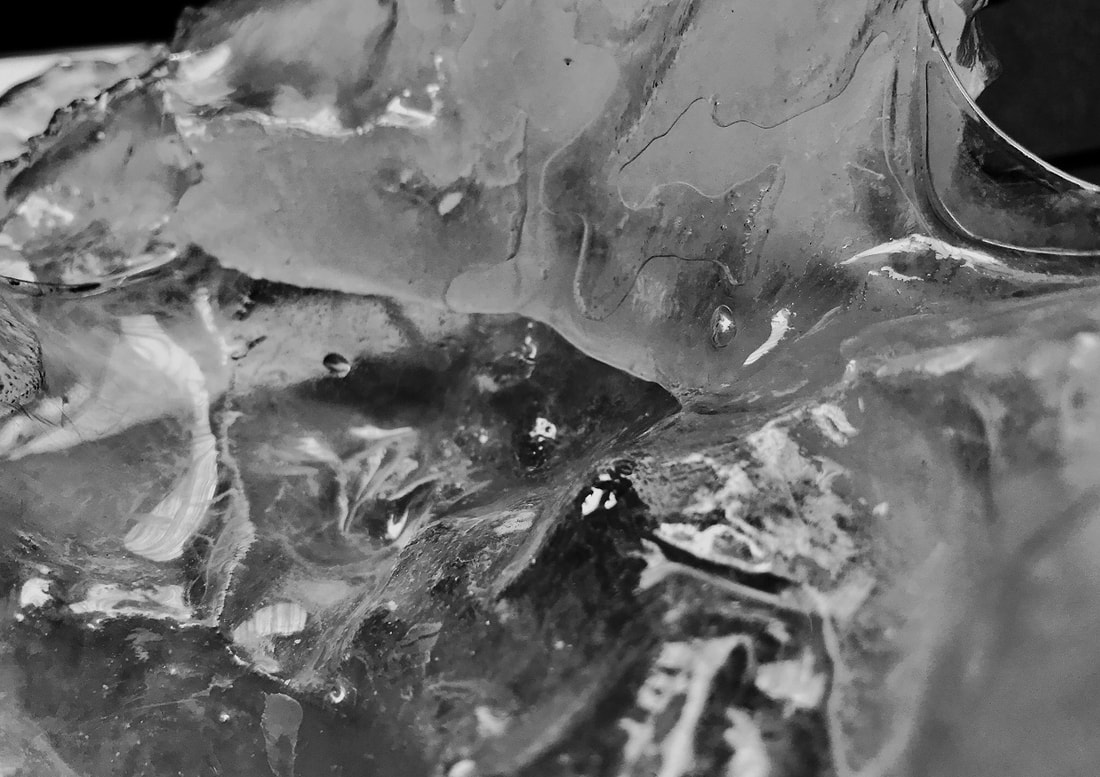
Encapsulate
Hannah Ball
Hannah's work researches the relationship between art and science, investigating the natural phenomena of water, light and sound. Collaborating with scientists, who perform experiments in a laboratory environment using water as the main driving force, she creates illusions using equipment such as generators, amplifiers and oscilloscopes. Interactive sound installations are created using musical instruments, such as the piano. She endeavours to illuminate and capture the emotion of landscapes, using sonic technology. Her work is intended to provide a sensory experience for viewers, who are guided through a series of interactive spaces. She uses a variety of media such as; sculpture, sound, film, photography and paint. She is interested in auditory and visionary perception as experienced by the individual viewer and as a scientifically observable event, together with the philosophical issues to which these things give expression. Sound and vision become both individual and scientifically labelled entities. Through her performance installations she wants her audiences to experience the impact of these sensory elements and, in doing so, think about the nature and representation of existence.
For more see @hannahballart
Hannah Ball
Hannah's work researches the relationship between art and science, investigating the natural phenomena of water, light and sound. Collaborating with scientists, who perform experiments in a laboratory environment using water as the main driving force, she creates illusions using equipment such as generators, amplifiers and oscilloscopes. Interactive sound installations are created using musical instruments, such as the piano. She endeavours to illuminate and capture the emotion of landscapes, using sonic technology. Her work is intended to provide a sensory experience for viewers, who are guided through a series of interactive spaces. She uses a variety of media such as; sculpture, sound, film, photography and paint. She is interested in auditory and visionary perception as experienced by the individual viewer and as a scientifically observable event, together with the philosophical issues to which these things give expression. Sound and vision become both individual and scientifically labelled entities. Through her performance installations she wants her audiences to experience the impact of these sensory elements and, in doing so, think about the nature and representation of existence.
For more see @hannahballart
